EN
EN


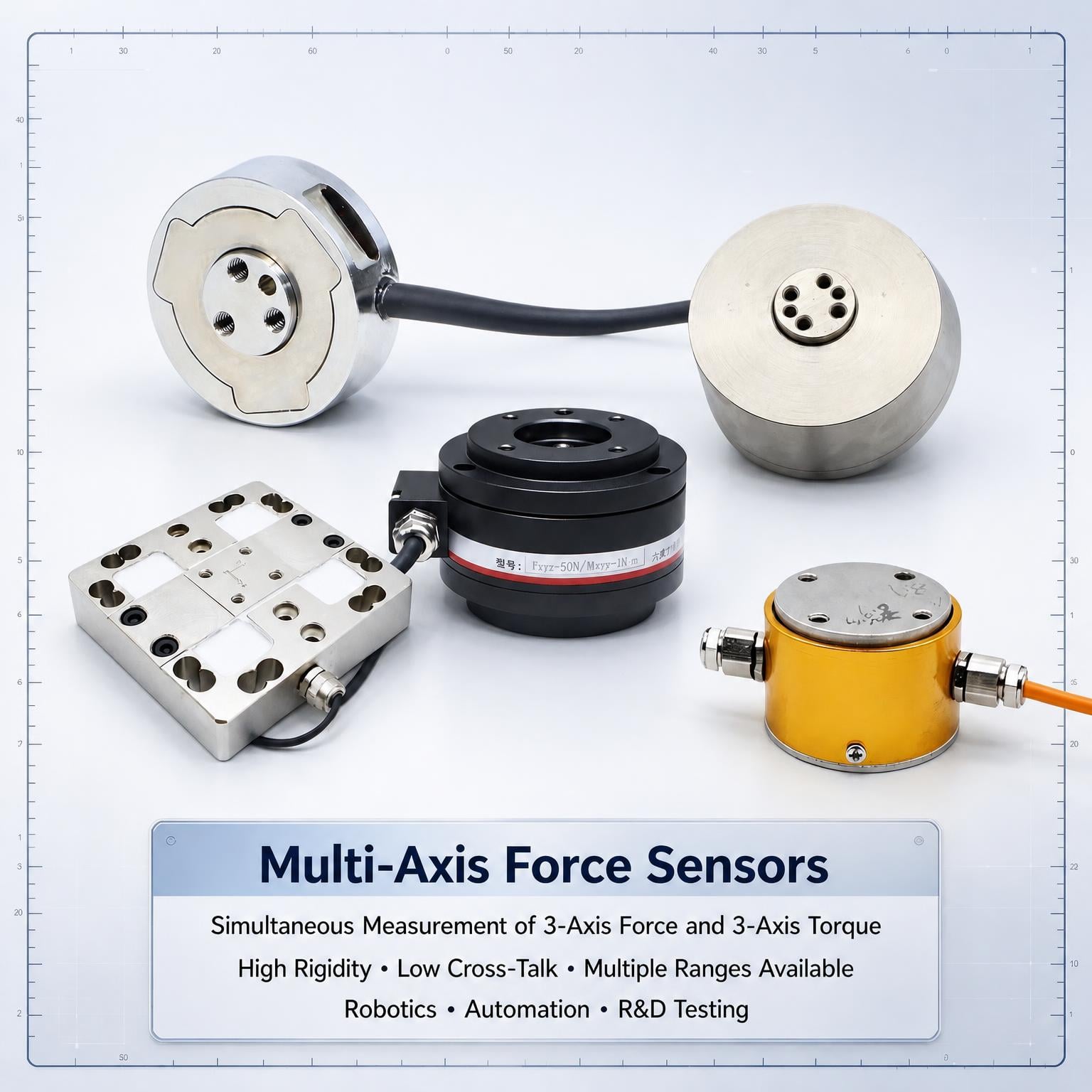
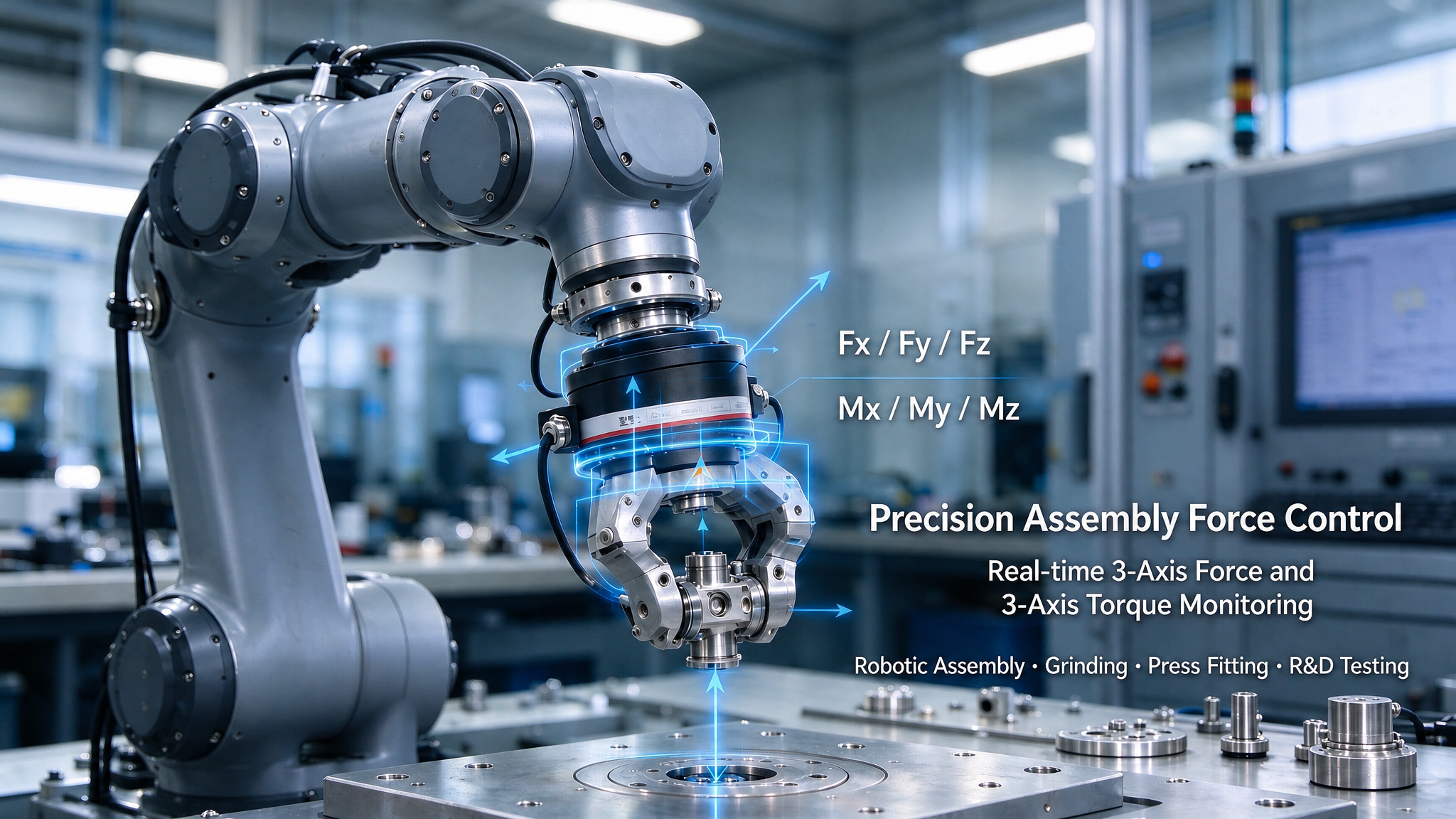
In the fields of robot polishing, precision assembly and scientific research mechanics test, the six-axis force sensor can simultaneously collect data of three directional forces (Fx, Fy, Fz) and three directional moments (Mx, My, Mz). Many users tend to only pay attention to the axial force range and ignore the torque matching when selecting the type, which leads to the sensor being overloaded and damaged quickly or the detection sensitivity is insufficient due to the excessive range. Reasonable matching of force and torque ranges is the key to make good use of multi-dimensional force sensors.
First of all, it is necessary to sort out the actual stress conditions of the equipment and distinguish between static stress and dynamic impact load. Under many working conditions, the axial force is not large, but the point of force is far from the installation end face of the sensor, which will form a great overturning moment. Even if the axial force does not exceed the rated value, the overturning moment may still exceed the torque range, directly causing elastic body damage, which is also a common cause of multi-dimensional sensor failure. When selecting the model, the specifications cannot be determined simply according to the axial tension and pressure, and the overturning moment generated under the actual working conditions must be accounted for. Secondly, the force range and torque range do not have to be in a fixed proportion. There are many non-standard customized multi-dimensional force sensors in the market, which can realize large force range with small torque range or small force range with large torque range. For example, in the fine grinding operation of the robot, the contact force is very small, but the cantilever is long, which is easy to produce large overturning moment, so it is suitable to choose the configuration with small force and large moment; However, in the press-fitting test condition, the axial pressure is large and the overturning moment is small, so the scheme of large force and small moment is preferred.
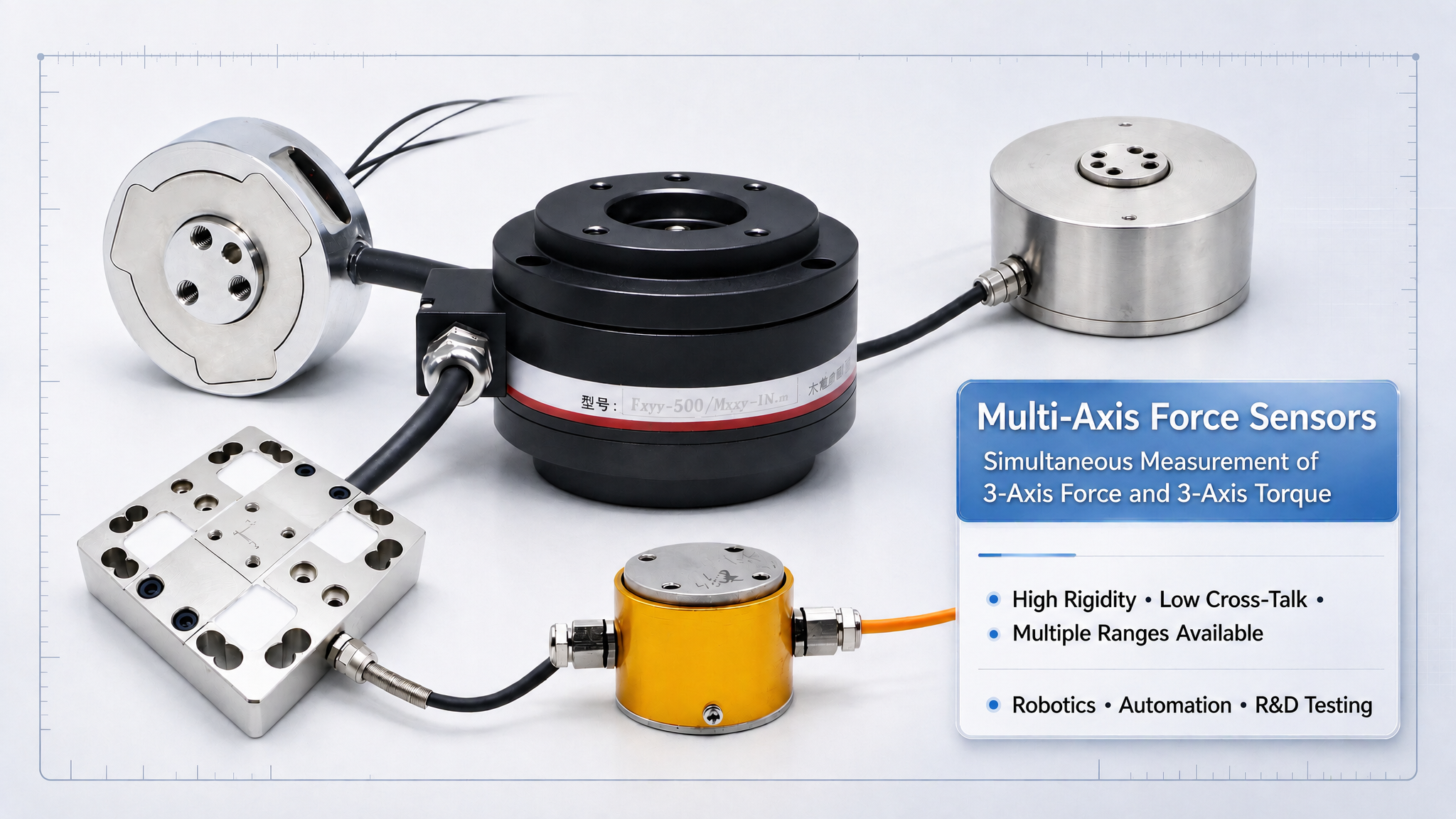
At the same time, a safety margin needs to be reserved. It is suggested that a safety factor of 1.22 times should be reserved on the basis of theoretical calculation load, so as to prevent instantaneous overload of dynamic impact; Don't blindly choose the super-large range. If the range is too large, the weak force signal will be easily drowned by noise, which will reduce the measurement accuracy and lose the effect of fine force control.
In addition, the installation structure will indirectly affect the actual stress state. Unreasonable tooling and excessively long adapter flange will amplify the overturning moment. While determining the measuring range, we should also optimize the mechanical installation scheme synchronously to reduce the interference of extra torque.
In a word, the selection of six-axis force sensor is not simply to select the maximum force index. Only by fully analyzing the field working conditions, accounting the overturning moment, reasonably matching the range of force and moment, and taking into account the safety margin and detection sensitivity, can the multi-dimensional force sensor give full play to its performance and serve various test scenarios such as robot manual control, automatic test and scientific research calibration.
Six-axis force sensor can detect XYZ three-dimensional force and three-dimensional moment synchronously, which is the core sensing equipment in the field of intelligent automation and precision detection.
Main application scenarios:
Collaborative robot manual control operation, robot flexible grinding and polishing, automatic assembly of precision parts, on-line detection of industrial press-fitting, robot drag teaching, robot anti-collision adaptive grasping, mechanical test of automobile parts, aerospace structural load test, force measurement of medical robots, force monitoring of rehabilitation equipment, mechanical research experiments in colleges and universities, and performance calibration test of new materials.