 EN
EN


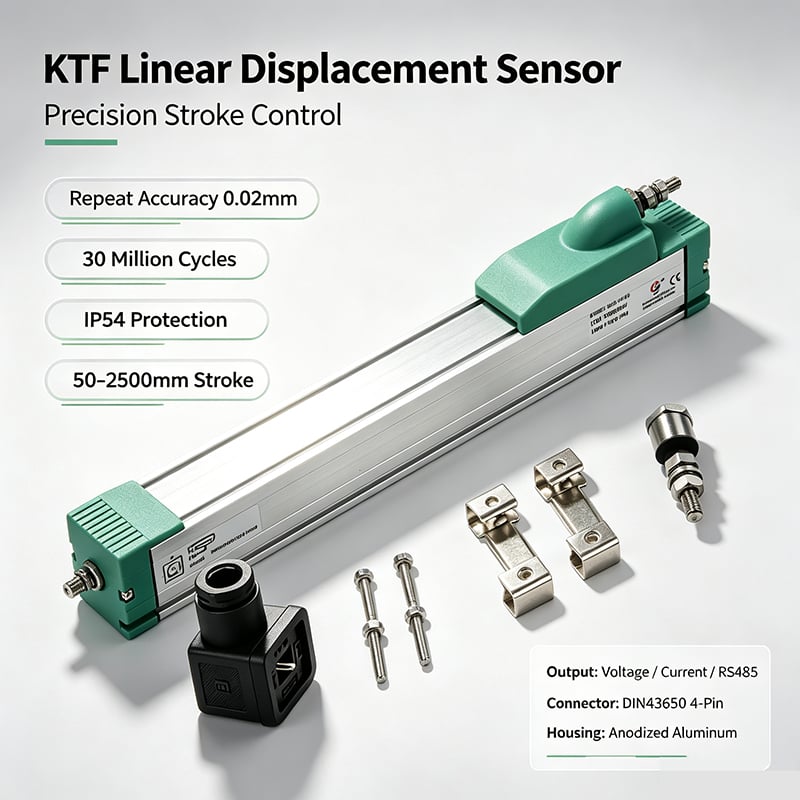
KTF Linear Displacement Sensor for Hydraulic Press Precision Control
Hydraulic presses are widely used in metal stamping, powder molding, and hardware bending processes. Accurate control of cylinder pressing depth, holding position, and return limit directly determines product yield and equipment safety. Traditional mechanical limit switches only trigger at fixed points without continuous real-time position monitoring, which easily causes overpressing, dimensional errors, and cylinder collisions. The KTF slider-type conductive plastic linear displacement sensor perfectly solves the closed-loop control problems of hydraulic equipment.
Adopting a rodless slider structure, the sensor is fitted with a spherical hinge to offset lateral force during hydraulic press operation and prevent internal component damage. It has a mechanical service life of more than 30 million cycles, fully adapting to the high-frequency reciprocating movement of hydraulic cylinders. With a repeat accuracy of 0.02 mm, low non-linearity, and infinite resolution, it can collect full-stroke dynamic displacement data of the oil cylinder in real time.
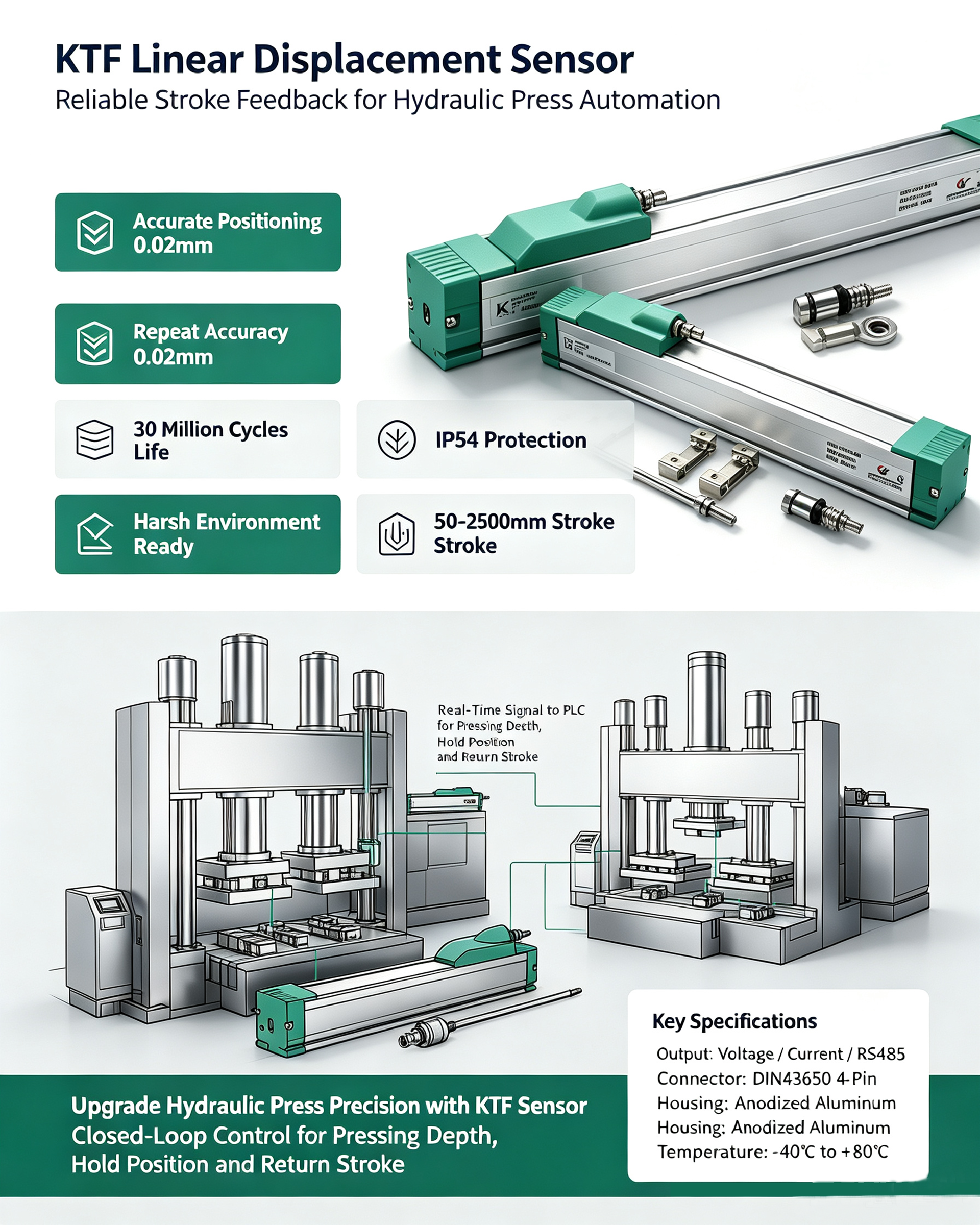
Its measuring stroke ranges from 50mm to 2500mm, compatible with small desktop hydraulic presses and large four-column hydraulic presses of all specifications. The anodized aluminum shell is anti-static and non-conductive. With an IP54 protection grade, it resists oil and dust in harsh workshop environments and runs stably at operating temperatures from -40℃ to +80℃. Supporting a maximum detection speed of 2 m/s, it comes with a standard 4-pin connector. Optional voltage/current modules and RS485 modules can be added for direct signal connection to the PLC control system.
On hydraulic presses, the sensor slides synchronously with the cylinder moving parts and outputs continuous accurate position signals. The control system automatically adjusts pressing endpoints, holding positions, and retraction strokes according to preset values to realize automatic closed-loop regulation. It effectively avoids overtravel collision and mold damage, unifies workpiece dimensional accuracy in mass production, and reduces reject rates, providing a reliable and cost-effective precision upgrading solution for automated hydraulic press systems.