 EN
EN



Precision injection molding is one of the most demanding processes in modern manufacturing. Whether producing thin-walled electronics housings, automotive components, or medical-grade plastic parts, the quality of every finished part hinges on two critical parameters: the exact position of the injection screw at each stage of the cycle, and the speed at which it advances through each phase.
Even a deviation of fractions of a millimetre in screw position — or an uncontrolled variation in injection speed — can result in short shots, flash, sink marks, or internal stress that renders the part defective. Traditional feedback methods using limit switches or encoder-based systems frequently fell short: they struggled with the combination of high-speed movement, cyclic loading, hydraulic oil contamination, and the tight physical envelope of the machine's injection unit.
The customer required a sensor solution capable of continuous, high-resolution position feedback along the full injection stroke — reliably, cycle after cycle, in a hot, oil-rich industrial environment.
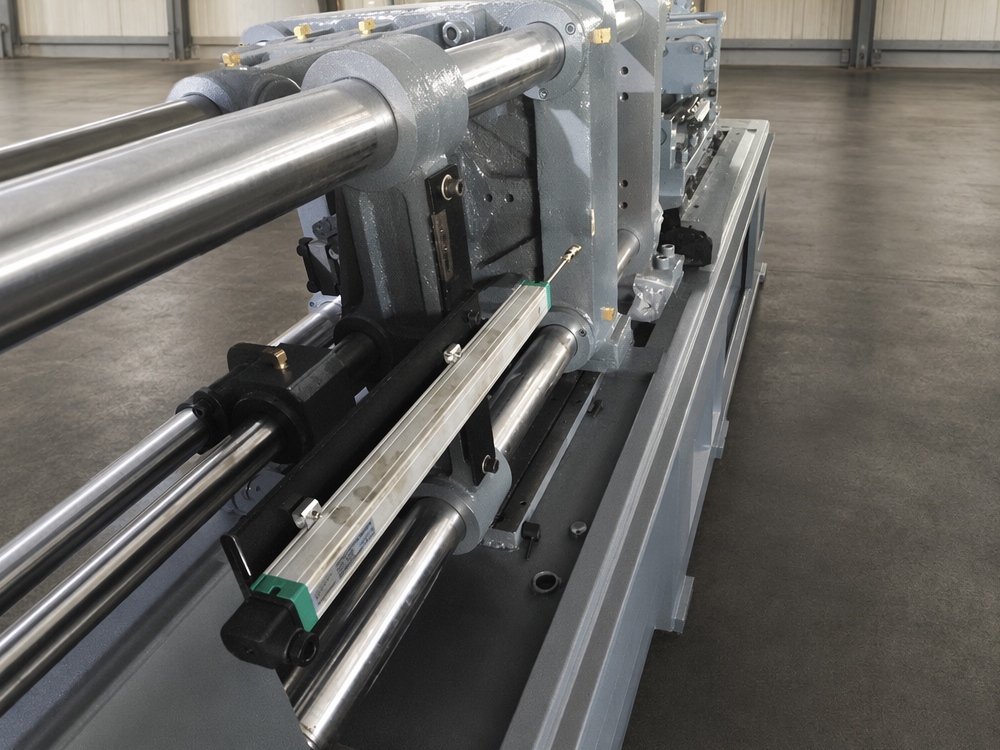
The customer integrated a SOP linear displacement sensor — from the KTC series — directly onto the injection unit rail, as shown in the field photograph. The sensor body runs parallel to the injection screw travel path, with the rod end mechanically coupled to the moving injection carriage. This configuration captures the full stroke of the screw in real time. Key reasons for selecting SOP:
• Full-stroke continuous measurement — no blind spots at either end of the injection travel, unlike limit-switch-based systems
• High resolution analogue output — the PLC receives a smooth, high-resolution signal that enables fine-grained velocity profiling across all injection phases (fill, pack, hold)
• Compact rail-mount design — the slim sensor profile installs within the machine's existing envelope without structural modifications
• Oil & contamination resistance — sealed construction prevents hydraulic fluid, lubricant mist, and plastic particles from degrading sensor accuracy or service life
• Long operating life — the wear-resistant resistive element is rated for tens of millions of cycles, matching the productive life of the molding machine itself
With the sensor signal fed directly into the machine's PLC, the injection controller can execute velocity profiles with closed-loop precision — ramping injection speed up or down at exact screw positions, automatically compensating for hydraulic pressure fluctuations, and logging the actual position trace of every shot for quality traceability.
01 |
Injection screw advances — sensor rod moves with the carriage along the full stroke |
02 |
Resistive track converts linear position to a proportional analogue voltage in real time |
03 |
PLC reads position signal and calculates instantaneous injection speed (dX/dt) |
04 |
Controller adjusts hydraulic valve opening to maintain the programmed velocity profile at each stroke position |
05 |
Completed injection data (position trace + speed curve) is logged per shot for SPC and quality records |
Parameter |
Value |
Note |
Application |
Injection molding machine |
Injection unit screw travel |
Sensor type |
KTC rail-mount series |
|
Measurement |
Full injection stroke position |
Continuous analogue output |
Derived parameter |
Injection speed (dX/dt) |
Calculated by PLC from position |
Environment |
High temp, oil mist, vibration |
Sealed, industrial-grade housing |
Key benefit |
Closed-loop injection control |
Reduces defect rate, improves repeatability |
After deploying the SOP linear sensor, the customer reported a measurable reduction in short-shot and flash defects, a tighter part-weight distribution across production runs, and improved repeatability of the injection velocity profile. The sensor's long-stroke continuous output also enabled the engineering team to fine-tune multi-stage injection profiles that were simply not achievable with their previous limit-switch feedback system.
SOP's linear displacement sensor range has been proven across hundreds of injection molding machine installations worldwide. The combination of performance and durability makes them the preferred choice for OEM machine builders and aftermarket retrofits alike:
• Stroke range from 50mm to 1250mm — covers micro-injection units through to large tonnage machines
• Linearity ±0.05% — meets the precision requirements of medical, automotive, and optical-grade molding
• IP65-rated sealed housing — fully protected against hydraulic oil immersion and wash-down cleaning
• Operating temperature -30°C to +100°C — suitable for machines running high-temperature engineering resins
• OEM custom configurations available — cable exit direction, connector type, stroke, and mounting interface tailored to machine layout
If you are designing, upgrading, or retrofitting an injection molding machine — or any industrial automation system requiring precise, continuous linear position feedback — contact SOP to discuss the right sensor model and configuration for your application.
KTC Linear Displacement Sensor Range: https://www.sopsensors.com/ktc
Contact SOP for a Custom Solution: https://www.sopsensors.com/contact


