EN
EN

Sensors convert physical quantities into measurable signals. Their reliable operation depends not only on the sensing element but also on key accessories such as housings, signal conditioners, connectors, and mounting hardware. Below, five important sensor types are described, including their working principles and essential accessories.
1. Linear Sensors (Potentiometric or Magnetostrictive)
Working principle: Potentiometric linear sensors use a resistive track and a wiper. As the wiper moves linearly, the resistance changes proportionally, producing a voltage divider output. Magnetostrictive sensors contain a waveguide and a permanent magnet; an electrical pulse generates a strain pulse that reflects from the magnet’s position, and the time delay indicates displacement.
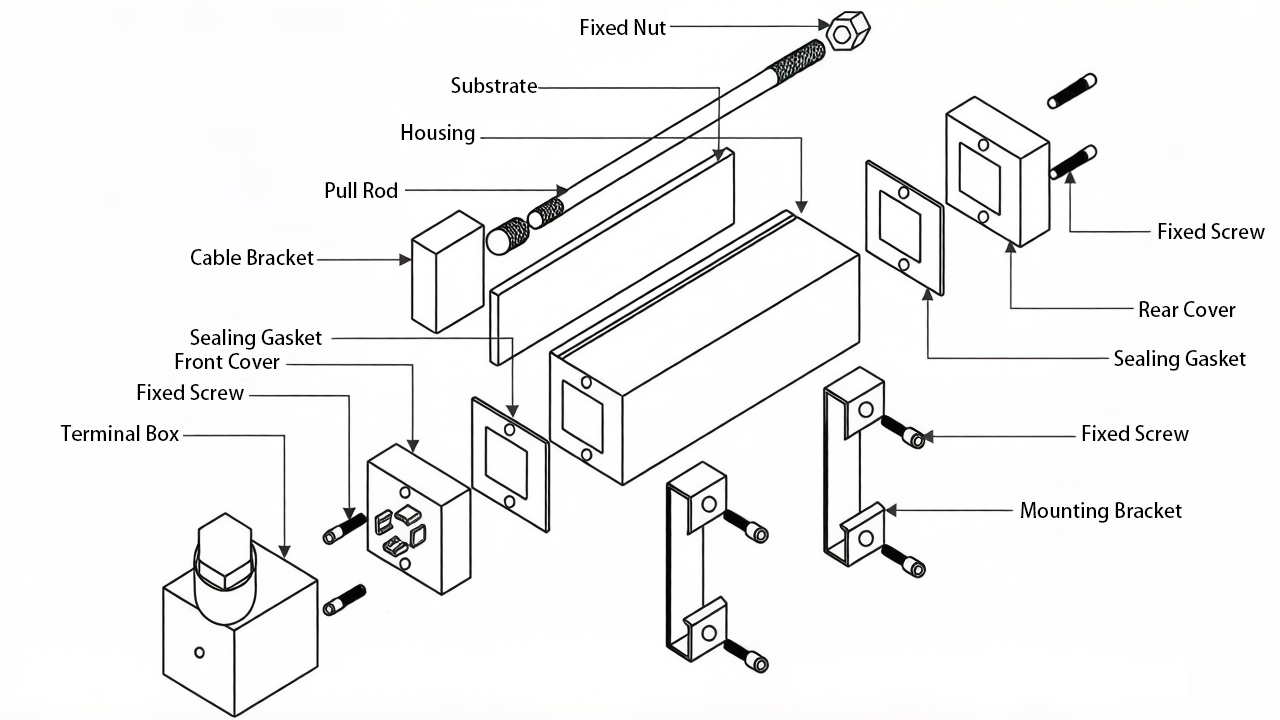
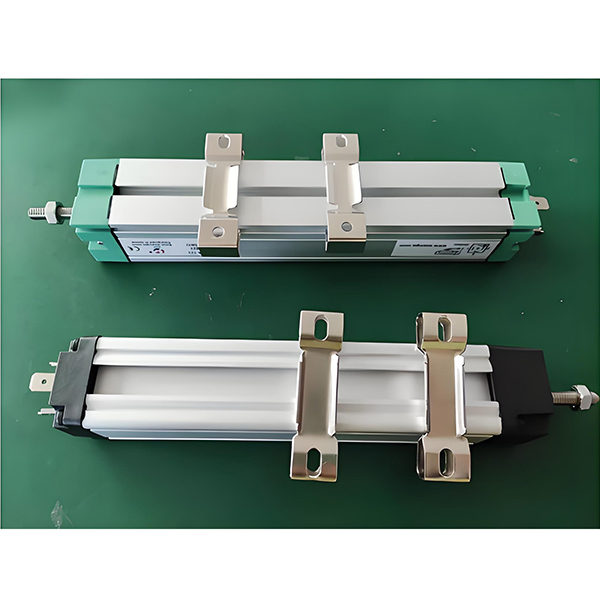
Main accessories: Weatherproof housings (IP67), rod ends or spherical bearings for mechanical coupling, cable assemblies with shielding, and signal conditioners that convert resistance or time delay into 4–20 mA or 0–10 V outputs.
2. Weighing Sensors (Load Cells – Strain Gauge Type)
Working principle: Most load cells use a metal spring element (e.g., beam, S type, or pancake) with four strain gauges connected in a Wheatstone bridge. When a force is applied, the element deforms, creating tension in two gauges (resistance increase) and compression in the other two (resistance decrease). The bridge outputs a millivolt signal proportional to the load.
Main accessories: Stainless steel or alloy tool steel housings for corrosion protection, loading buttons and mounting plates, junction boxes for summing multiple cells, and precision amplifiers (with excitation voltage regulation and temperature compensation).
3. LVDT (Linear Variable Differential Transformer)
Working principle: An LVDT consists of a primary coil and two secondary coils wound on a hollow tube. A ferromagnetic core moves linearly inside the tube. The primary is excited by an AC signal (typically 1–10 kHz). The two secondaries are connected in series opposition; when the core is centered, their induced voltages cancel (zero output). Moving the core unbalances the voltages, producing an AC output whose amplitude is proportional to displacement and whose phase indicates direction.
Main accessories: Stainless steel or epoxy encapsulated housings for harsh environments, threaded core rods and spring loaded probes, signal conditioners that demodulate the AC output into DC voltage or 4–20 mA, and connector cables with low capacitance.
4. Torque Sensors (Reaction or Rotary Type)
Working principle: Most torque sensors use strain gauges bonded to a shaft or flange. In reaction torque sensors, the body is fixed, and strain gauges measure the twisting moment. In rotary torque sensors, a rotating shaft is fitted with strain gauges or a magnetoelastic element; the signal is transmitted via slip rings, inductive coupling, or radio telemetry. The resistance change of the gauges (Wheatstone bridge) is directly proportional to torque.
Main accessories: Splined or keyed shafts for positive drive, slip ring assemblies (for rotary types), wireless telemetry modules, protective enclosures with sealed bearings, and amplifier/conditioning units that provide filtered, calibrated voltage or current outputs.
General Accessories Across Types
Signal conditioners (amplifiers, filters, linearization circuits), electrical connectors (M12, DIN), mounting brackets, and calibration tools are common to many sensors. Proper selection of accessories ensures accuracy, longevity, and electromagnetic compatibility.
Understanding both the sensing principle and the accompanying hardware is essential for engineers to deploy these sensors reliably in industrial automation, automotive testing, robotics, and process control.